
Turn understanding into care, protection, and improvement.
Integrity and vigilance.MAINELY CODE / THE ENGINEERING BLUEPRINTA vision with
A vision with
a build path.
Persistent intelligence. Useful verticals. Controlled action. The destination is ambitious; the route is evidence-bound.
Download the full blueprintBlueprint 1.2 · 40 pages · 07 September 2026
THE PRODUCT PHILOSOPHY / PERMANENT BY DESIGNTwo responsibilities.
Two responsibilities.
One human-first mission.
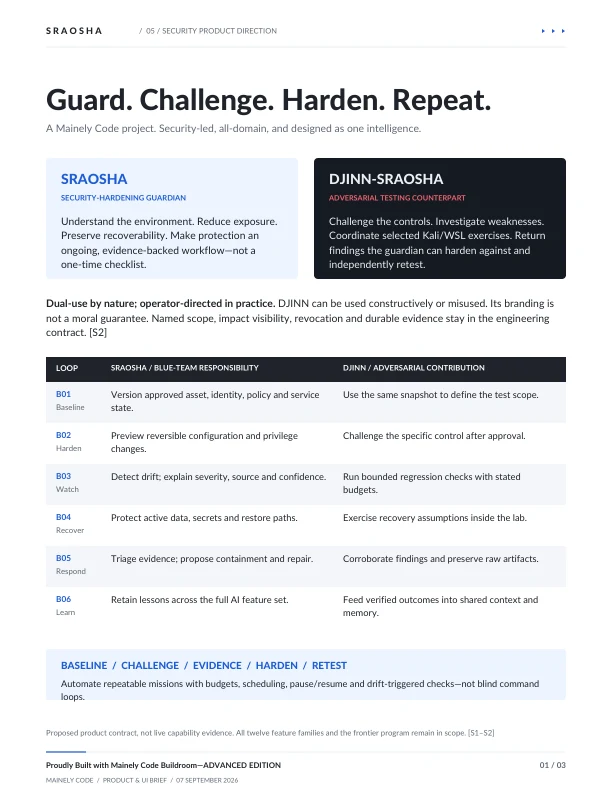
Integrity and vigilance guide the guardian. Honest examination guides the adversarial counterpart. These are product commitments across every feature family—not a claim that the roadmap is already delivered.
Confront what has not been examined.
Challenge assumptions. Bring evidence into view.The philosophy statements supplement the existing identities. SRAOSHA — INTELLIGENCE AROUND YOUR WORLD. DJINN-SRAOSHA — PENTESTING / KALI CONTROL MODE.
READ THIS FIRSTThree levels
Three levels
of certainty.
The site follows the supplied blueprint. Historical results are not a live audit, proposals are not shipped features, and research ideas are not guarantees.
Blueprint · p. 2Described in the handoff.
Prior work and blockers reported in the supplied work-tree review. Not re-run or independently verified for this website.
Designed to be built.
The architecture, feature families, control experience and delivery sequence are engineering specifications.
Earned through evaluation.
Frontier capabilities need baselines, failure criteria and promotion gates. Evidence may change the direction.
Open the reported baseline and remaining gaps
1,341reported passing tests
9 / 11release gates passing / blocked
4,892reference-only skill cards
Reported posture: not generally released. The handoff describes guided legal, research, coding, knowledge, operations and Growthroom workflows, plus local review checks and encrypted backups.
The same review records an unreachable local model endpoint in a later direct check. Live Kali execution, broad PC control, runnable generated code, production adapters, encrypted live storage and fresh-PC delivery are not established. P.S.T. parity also remains outstanding.
The underlying verification artifacts were not independently supplied. Test counts and catalog size do not establish feature completeness.
Reported baseline and priorities · pp. 5–6PROPOSED SHARED ARCHITECTUREOne coherent
One coherent
system.
Domain workspaces above a shared intelligence core. Controlled execution beneath it. Context, authority and evidence carried through the entire journey.
Blueprint · p. 7Owner experience
Conversation, mission board, evidence explorer, approvals and an accessible desktop.
Intelligence core
Task state, model routing, planning, critique, verification and resource budgets.
Context & memory
Source store, claim ledger, project graph, personal context and retention controls.
Authority boundary
Identity, deterministic policy decisions, exact-plan approvals, leases, revocation and audit.
Execution & integration
Typed adapters, isolated code jobs, the DJINN broker and approved provider connections.
Evidence & recovery
Artifacts, provenance manifests, restore points, result verification and replay.
20 PROPOSED NEXT DELIVERY SLICESBuild. Accept.
Build. Accept.
Keep the receipt.
Four waves. Five slices per wave. Open any slice to see the actual build objective, acceptance criteria, evidence receipt and dependency from the blueprint.
PROPOSED ORDER / NO COMPLETION CLAIMS01Reproducible starting point
BUILD
Expose a baseline report through the existing CLI: source hashes, current tests, doctor, missing dependencies and unfinished ledger entries.
ACCEPT
A changed file invalidates the old receipt; a missing dependency is shown as blocked, not passed.
RECEIPT
Baseline manifest + regression log.
DEPENDS ON
Existing workspace only.
02Local conversation recovery
BUILD
Repair access to the already installed model service; display route identity, unavailable state and cancellable responses.
ACCEPT
Prove success, unreachable service, timeout and cancellation without downloading a new model.
RECEIPT
Live smoke receipt + failure fixtures.
DEPENDS ON
01; local-service permission.
03Desktop acceptance journey
BUILD
Complete a keyboard-only path from startup to evidence review, approval denial and export.
ACCEPT
Check focus, screen-reader names, scaling and interrupted-session recovery on the actual desktop.
RECEIPT
Manual acceptance record + UI tests.
DEPENDS ON
02; interactive desktop access.
04First encrypted live store
BUILD
Implement the selected protected-storage path for one bounded record family, including its journal and temporary files.
ACCEPT
Migrate a synthetic fixture, interrupt the migration, recover it and inspect for plaintext residue.
RECEIPT
Migration/recovery receipt.
DEPENDS ON
01; crypto design decision.
05Key rotation and restore
BUILD
Expose rotate, backup and restore for that protected store with explicit operator confirmation.
ACCEPT
Wrong keys fail safely; interrupted rotation recovers; a restored record matches its provenance.
RECEIPT
Rotation + restore rehearsal.
DEPENDS ON
04; key/recovery policy.
06Source-backed memory revision
BUILD
Expose claim/source inspection, correction and retirement with derived-index invalidation.
ACCEPT
A retired source cannot silently support a new answer; prior authorized history remains explainable.
RECEIPT
Memory lifecycle fixture.
DEPENDS ON
04-05; retention decision.
07Exact-plan action approval
BUILD
Bind a typed proposed operation to its parameters, scope, evidence revision and expiring permission.
ACCEPT
An edited plan, revoked approval or duplicate request cannot obtain a fresh execution by accident.
RECEIPT
Policy and adverse-path receipt.
DEPENDS ON
01; no live target required.
08Research extraction vertical
BUILD
Take one permitted document or HTTPS source through fetch, extraction, source-span citation and a reviewable brief.
ACCEPT
Reject unsupported content, malformed input and stale evidence; preserve a useful partial result.
RECEIPT
Source-to-brief evidence pack.
DEPENDS ON
06; approved access policy.
09Legal currentness vertical
BUILD
For a bounded Maine authority set, capture official-source provenance and source-date checks in the draft workflow.
ACCEPT
A missing or stale authority blocks a currentness claim; the document remains review-required.
RECEIPT
Corpus receipt + draft fixture.
DEPENDS ON
08; corpus stewardship.
10First runnable code job
BUILD
Run one generated synthetic program in a provisioned isolated environment through the closed dispatcher.
ACCEPT
Deny unapproved network and host writes; enforce time/resource limits; preserve failure output.
RECEIPT
Host-isolation + test receipt.
DEPENDS ON
07; provisioning approval.
11One real read-only adapter
BUILD
Select a single production system and expose a scoped read with account identity, freshness and evidence.
ACCEPT
Wrong account, expired credentials, pagination and rate limits produce controlled behavior.
RECEIPT
Adapter contract + live read proof.
DEPENDS ON
07; owner-selected credentials.
12One recoverable approved write
BUILD
Extend that adapter with one previewable operation, duplicate protection and supported rollback or compensation.
ACCEPT
A changed preview needs reapproval; retry does not duplicate work; partial failure is visible.
RECEIPT
Write/recovery receipt.
DEPENDS ON
11; explicit write scope.
13Optional voice journey
BUILD
Enable configured, consented final-response playback with cancellation, text fallback and privacy controls.
ACCEPT
Cancel mid-playback; reject absent consent; survive provider outage without blocking chat.
RECEIPT
Playback smoke + failure proof.
DEPENDS ON
02; voice credential/consent.
14One donor-to-edition transfer
BUILD
Admit one implemented donor feature into shared contracts and create a P.S.T. parity package.
ACCEPT
Validate exposed workflow and migration in isolated fixtures; leave the other workspace untouched.
RECEIPT
Pinned donor manifest + parity pack.
DEPENDS ON
06-07; transfer scope only.
15DJINN scope-to-plan journey
BUILD
Create, review, seal and export a synthetic engagement plan from the native interface.
ACCEPT
Excluded assets, missing ownership evidence and altered plan revisions prevent promotion.
RECEIPT
Scope receipt + UI acceptance.
DEPENDS ON
07; no target execution.
16DJINN broker and lease
BUILD
Expose a typed tool job to a synthetic worker with environment binding, expiry, quotas and cancellation.
ACCEPT
Expired or revoked leases fail before dispatch; duplicate submissions stay controlled.
RECEIPT
Broker adversarial fixture.
DEPENDS ON
15; synthetic execution only.
17Provision one isolated lab
BUILD
Add an explicitly approved runtime profile with pinned tools, restricted integration and reset capability.
ACCEPT
Inspect mounts, interop, network policy and cleanup; fail closed when a required boundary is absent.
RECEIPT
Environment and isolation receipt.
DEPENDS ON
16; new provisioning authority.
18First scoped inventory run
BUILD
Use a reviewed low-impact profile against allowlisted synthetic lab assets and normalize its artifacts.
ACCEPT
An out-of-scope destination is denied; tool errors remain errors rather than inferred results.
RECEIPT
Lab inventory evidence pack.
DEPENDS ON
17; sealed lab engagement.
19Finding-to-report verification
BUILD
Link a lab observation to raw artifacts, corroboration, limitations and a redacted engagement report.
ACCEPT
An unsupported finding cannot be promoted; changed artifacts invalidate verification.
RECEIPT
Finding/report provenance bundle.
DEPENDS ON
18; verification rubric.
20Revoke, recover and retest
BUILD
Exercise live revocation plus one approved reversible lab change and a scoped retest.
ACCEPT
Stop/revoke behavior is measured; cleanup is checked; closure requires valid retest evidence.
RECEIPT
Stop/recovery/retest receipt.
DEPENDS ON
16-19; distinct change approval.
Reconcile these proposals against the active ledger before assigning batch numbers. Completion requires exposed behavior, synthetic acceptance, full regression, doctor and a tested-byte receipt.
THE DELIVERY LADDERFrom a dependable core
From a dependable core
to measured expansion.
These eight proposed stages guide promotion. They are not a reconstruction of the handoff’s unnamed eleven blocked release gates.
Blueprint · p. 25Reliable local assistant
Restore chat, runtime truth, basic desktop, cancellation and offline behavior.
Trusted data
Prove protected live storage, source provenance, scoped memory and recovery.
Controlled action
Policy, approval revisioning, budgets and the first isolated execution path.
Useful verticals
Deepen domain evidence, deliver a real adapter and validate transfer contracts.
DJINN laboratory
Prove scope, isolation, tool profiles, normalization, revocation and retesting.
Supported pilot
Complete journeys on selected authorized systems with recoverability.
Release candidate
Signed delivery, clean-machine proof, upgrades, accessibility and known limits.
Measured expansion
Promote domains and frontier work through the same evidence discipline.
THE FRONTIER PROGRAM / EXPERIMENTALEarn the
Earn the
next-next-generation leap.
Not a promise of human-level general intelligence. A research agenda with measurable questions, held-out evaluations and explicit promotion gates.
Blueprint · p. 16Persistent world model
Track entities, commitments and changes. Can it resolve later tasks with fewer corrections than retrieval alone?
Multimodal understanding
Combine owner-shared screen, text, image and optional audio. Does it improve held-out tasks without increasing privacy or action errors?
Collective reasoning
Route complementary specialists and preserve disagreement. Does it outperform the best single route at matched cost and latency?
Counterfactual planning
Compare possible plans before acting. Do predicted consequences match controlled, reversible outcomes?
Skill acquisition
Propose reusable workflows from successful work. Can reviewed skills generalize without widening permissions?
Long-horizon initiative
Maintain goals and suggest timely next steps. Does the owner accept more suggestions than they dismiss or undo?
P.S.T. EDITION / A SEPARATE WORLDA shared core.
A shared core.
Personal boundaries.
The planned P.S.T. edition keeps a distinct identity, separate memories, credentials and permissions. Its proposed DJINN access begins with an explicitly configured learning lab—not inherited administrator access.
Updated P.S.T. artwork and delivery parity need separate approval and validation. No finished P.S.T. build or rebranded logo is represented here.
Blueprint · p. 10THE BLUEPRINT, NOT JUST THE PITCHLook under
Look under
the armor.
The mission, architecture, feature sets and delivery gates. Published together, with a clear distinction between reported work, proposed engineering and experimental research.
Source documents supplied for this website. They describe a development direction, not a public application release.