Be worthy of the trust.
Reason carefully. Communicate honestly. Acknowledge uncertainty. Act consistently with the responsibility entrusted to the system—including recognizing its own mistakes.
A security-hardening guardian. An adversarial testing counterpart. One owner-directed intelligence with a world of possibilities.
Turn understanding into care, protection, and improvement.
Security-led. All-domain. Human judgment stays in command.
Integrity and vigilance
“A suit of armor
around my world.”
SRAOSHA is being built toward a persistent intelligence that understands context, coordinates expertise, creates useful work and protects what matters.
Memory. Research. Engineering. Business. Your devices, projects and responsibilities. Security leads the product; all twelve feature families—and the larger intelligence ambition—remain in scope.
Mainely Code’s AI is not being built to take the jobs of human beings. It is being built to augment the people already doing the work—making them faster, more efficient and more reliable at the procedural tasks that consume their time.
The person stays in control. Human judgment, abstraction, compassion, context, governance and operational decisions remain with the people responsible for making them.
SRAOSHA takes aim at the procedural load: research, coding, CLI work, documentation, analysis and repeatable technical execution—so the human can spend more time on judgment and direction.
A culmination of technologies being developed across Mainely Code is going into this one. Public release may still be a year or so away—we have other projects to button up first—but the goal is to make it worth the wait.
Turn understanding into care, protection, and improvement.
Understanding is not the finish line. What matters is how we use it to care for people, protect what matters, and make their world better.
Reason carefully. Communicate honestly. Acknowledge uncertainty. Act consistently with the responsibility entrusted to the system—including recognizing its own mistakes.
Stay attentive to changing conditions, overlooked risks, and the consequences of action or inaction. Protection should support the person’s judgment, not take control away from them.
Augment the person. Support their judgment. The human stays in control.
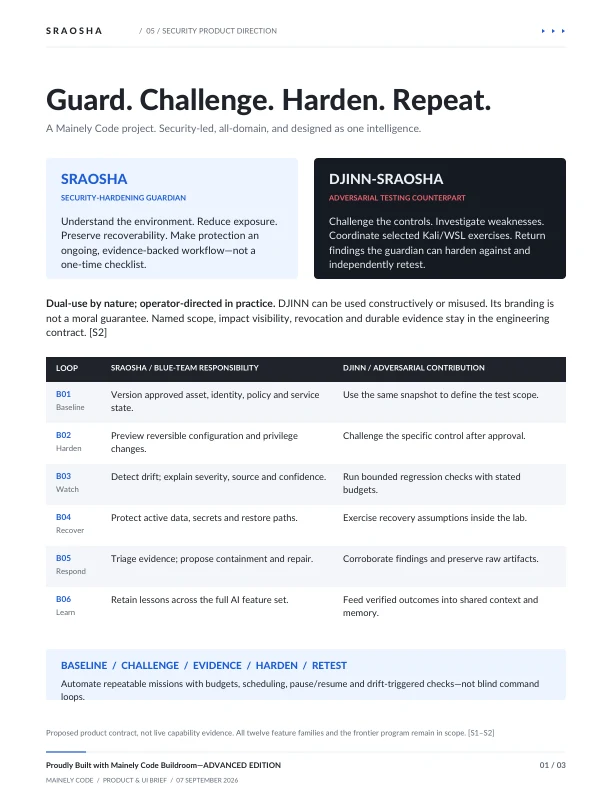
Blue-team protection. Red-team pressure. One proposed cycle that turns findings into hardening—and hardening into something worth testing again.
Explore the product contract · p. 35Turn understanding into care, protection, and improvement.
Integrity and vigilance.Confront what has not been examined.
Challenge assumptions. Bring evidence into view.Version approved asset, identity, policy and service state.
Use the same snapshot to define the test scope.
Preview reversible configuration and privilege changes.
Challenge the specific control after approval.
Detect drift and explain severity, source and confidence.
Run bounded regression checks with stated budgets.
Protect active data, secrets and restore paths.
Exercise recovery assumptions inside the lab.
Triage evidence and propose containment and repair.
Corroborate findings and preserve raw artifacts.
Retain lessons across the full AI feature set.
Feed verified outcomes into shared context and memory.
Proposed workflows. These are product responsibilities, not live system results.
Twelve planned capability families. Shared context, a common authority boundary and evidence that follows the work.
INTENDED FEATURE SET / NOT A RELEASE CHECKLIST12 planned capability families
Knowledge
Connect approved documents, notes and project records. Search by meaning and exact evidence, reconcile contradictions and assemble cited briefs.
Permission-aware retrieval and a source-backed answer that survives a stale-source test.
Reported baselineKnowledge workflows are reported in the supplied handoff.
Blueprint · p. 11Research
Plan research, compare sources, record uncertainty and preserve citations. The destination extends beyond bounded HTTPS reads into validated document and browser workflows.
Grounded synthesis with source dates, extraction checks and a failed-fetch path.
Reported baselineBounded HTTPS reads are reported; broader validation remains proposed.
Blueprint · p. 11Legal work
Organize matters, retrieve jurisdiction-specific authorities, build timelines and draft review-required documents.
A maintained official corpus, currentness receipts, verified forms and qualified review where required.
Reported baselineLocal Maine workflows are reported, not filing readiness.
Blueprint · p. 11Personal operations
Maintain goals, obligations, checklists and shared plans through selected, authorized connections. Explain changes before committing them.
A planning-to-confirmed-update journey with cancellation and duplicate prevention.
Reported baselineThis broader family is not proven by the handoff.
Blueprint · p. 11Engineering
Inspect a workspace, plan changes, create patches, run approved isolated tests and prepare a reviewable package.
A patch-to-test receipt with dependency isolation and an unchanged host.
Reported baselineGenerated code is intentionally inert in the reported baseline.
Blueprint · p. 12IT & infrastructure
Unify selected inventory, documentation, network and service workflows. Correlate changes and propose recoverable maintenance.
A least-privilege adapter with fresh reads, an approved write and rollback or explicit compensation.
Reported baselineThe handoff reports deterministic local workflows, not live production adapters.
Blueprint · p. 12Business & growth
Research leads, draft campaigns, manage content and connect selected CRM or publishing systems under approval and consent rules.
Truthful preview, scoped publication, duplicate prevention and a receipt.
Reported baselineGrowthroom UI is reported; authenticated production adapters are not.
Blueprint · p. 12Creation & documents
Produce structured reports, presentations, interfaces, design briefs and media plans with source provenance and approved brand assets.
An editable artifact, a rendered quality check and transparent source attribution.
Reported baselineComplete creative coverage is not established by the handoff.
Blueprint · p. 12Device workflows
Understand explicitly shared screens and device state. Add authorized desktop actions behind a tested execution boundary.
Focus-safe, cancellable actions that stop when the screen or target changes.
Reported baselineThe reported baseline is observation and focus only.
Blueprint · p. 13Home & family
Support household projects, schedules and maintenance. Separate private contexts and make enabled observation visible.
Transparent consent, revocable sharing and no cross-profile leakage.
Reported baselineThis broader family is not proven by the handoff.
Blueprint · p. 13Learning & adaptation
Tutor from selected sources, retain progress and turn successful workflows into reviewable, reusable skills.
Better held-out task performance without silently changing permissions or accepted facts.
Reported baselineFrontier work remains experimental and requires evaluation.
Blueprint · p. 13Security
SRAOSHA baselines, hardens and watches drift. DJINN tests controls through scoped Kali/WSL workflows and returns evidence for repair.
A lab cycle with before/after state, a reversible fix, independent retest and a reliable stop.
Reported baselineKali catalog, WSL inventory and planning only in the reported baseline.
Blueprint · p. 13No capability matches that search. Try another term or select “All twelve.”
The mission, architecture, feature sets and delivery gates. Published together, with a clear distinction between reported work, proposed engineering and experimental research.
Source documents supplied for this website. They describe a development direction, not a public application release.
No. Security is the lead identity, not the ceiling. Knowledge, research, legal work, personal operations, engineering, IT, business, creation, devices, home and family, learning, and security all remain in the blueprint.
Feature atlas · pp. 11–13The specialized adversarial testing and Kali control mode within the broader SRAOSHA system. Its proposed role is to challenge controls and return evidence for hardening and retesting. The blueprint acknowledges its dual-use nature and keeps target scope, impact, authority and evidence visible.
Blueprint · p. 18This is the project website, not an application distribution portal. The downloads are the supplied blueprint and product brief. The blueprint’s reported baseline is not generally released and there is no public installer yet. The current direction is roughly a year or so before release, with other Mainely Code projects to button up first; that is a development horizon, not a guaranteed launch date.
Reported baseline · p. 5No. It is a static website. The interactive command concept is a browser-only walkthrough with synthetic labels. It has no shell, Kali, WSL, account or target connection.
The blueprint retains a separate P.S.T. edition with its own identity, memories, credentials and permissions. Updated artwork and delivery parity require separate approval and validation; neither is presented as finished on this site.
Blueprint · p. 10